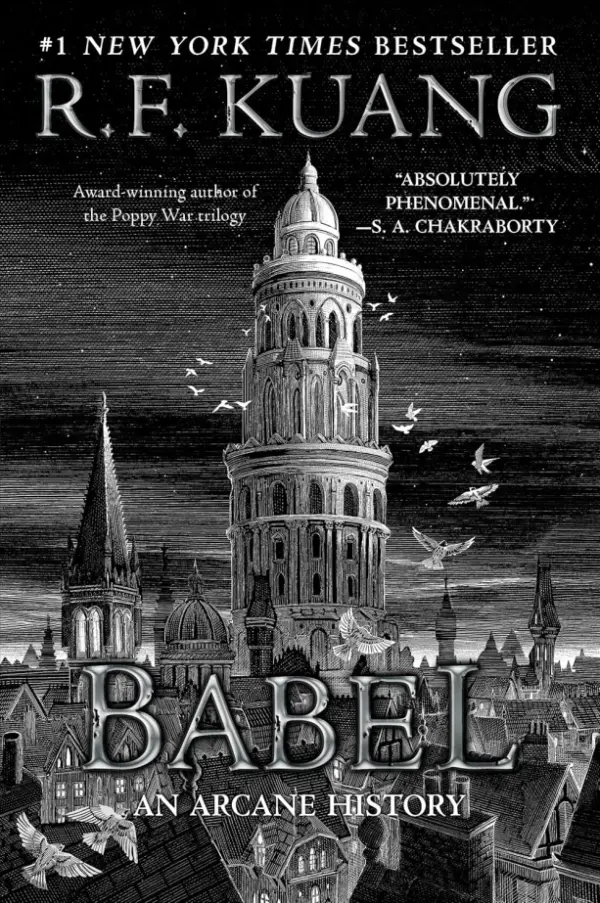
Babel
R. F. Kuang
Average Goodreads rating4.2
- Rebellion Against Oppressive System
- Political and Social Commentary

Book trope · 7 books
Some secrets exist for a reason. The forbidden knowledge trope centres on information, power, or understanding that has been locked away, suppressed, or declared off-limits — and the characters who cannot help but reach for it anyway.
More about the Forbidden Knowledge trope1 is tagged with Forbidden Knowledge individually. The others belong to a series tagged with it, which doesn’t mean every book in it features the trope, so they’re marked “Matched via its series”.
Updating books…
7 books found
R. F. Kuang
Average Goodreads rating4.2
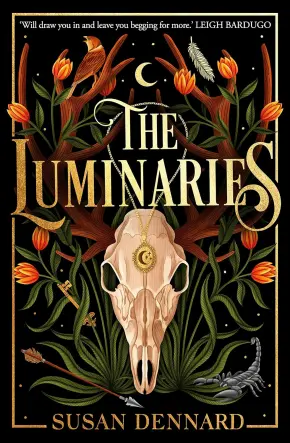
Susan Dennard
The Luminaries, book 1
Average Goodreads rating4.3
Matched via its series

Olivie Blake
Atlas, book 1
Average Goodreads rating4.0
Matched via its series
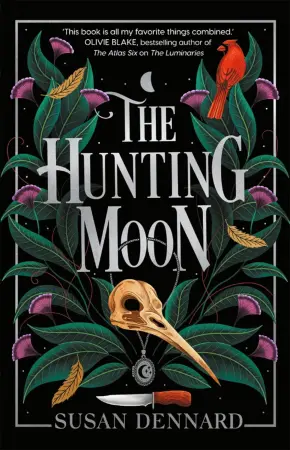
Susan Dennard
The Luminaries, book 2
Average Goodreads rating4.4
Matched via its series
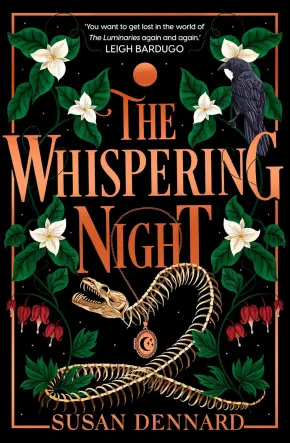
Susan Dennard
The Luminaries, book 3
Average Goodreads rating4.5
Matched via its series

Olivie Blake
Atlas, book 3
Average Goodreads rating3.4
Matched via its series

Olivie Blake
Atlas, book 2
Average Goodreads rating3.1
Matched via its series
Tropes that share the most books with Forbidden Knowledge
Some secrets exist for a reason. The forbidden knowledge trope centres on information, power, or understanding that has been locked away, suppressed, or declared off-limits — and the characters who cannot help but reach for it anyway. It's one of the oldest tensions in storytelling, rooted in the simple, devastating fact that telling someone not to look is practically an invitation.
In fantasy and romance, this takes countless forms: a spell that was outlawed for good reason, a historical truth that the ruling class has buried, a name that must never be spoken, a prophecy kept from the very person it concerns. The knowledge itself might be dangerous, or it might simply be inconvenient to those in power. Either way, the act of seeking it — and the consequences of finding it — is where the story lives.
There's something deeply satisfying about a protagonist who refuses to accept the boundary. Readers tend to root for the curious, the persistent, the ones who ask why when everyone around them has learned to stay quiet. Forbidden knowledge gives those characters a concrete goal, but more importantly, it gives them a reason to be afraid — and to press on regardless.
The trope also does something few others manage as elegantly: it makes the world feel larger than what's on the page. If knowledge has been forbidden, that implies a history, a power structure, a moment when someone decided the truth was too dangerous to share. That implication alone can carry enormous narrative weight, building tension before a single secret is revealed.
In epic fantasy, forbidden knowledge often takes the shape of ancient magic or a forgotten language — something deliberately erased from the record books, surviving only in ruins or in the memories of those old enough to remember when it was legal to know. The seeking becomes archaeological as much as magical.
Dark fantasy and gothic romance lean into the horror of it. Here, the knowledge is forbidden because encountering it changes you. You cannot unknow what you've learned, and the trope uses that irreversibility to devastating effect. Characters emerge from their pursuit altered, sometimes in ways they didn't consent to.
In secondary-world romance, it frequently drives the central relationship — two characters who shouldn't be sharing what they know, whose growing intimacy is measured in the secrets they choose to trust each other with. The forbidden knowledge becomes a form of vulnerability, and vulnerability becomes desire.
The trope only earns its weight when the knowledge actually matters. Vague warnings and ominous silences are setup; what pays them off is a revelation that genuinely recontextualises everything the reader thought they understood. The best versions don't just explain — they implicate. The protagonist learns something, and that learning makes them complicit, or hunted, or irrevocably changed.
Stakes are everything here. Knowledge that carries no real cost to possess isn't forbidden — it's just inconvenient. When a book gets this right, the moment of discovery carries the same charge as any action set piece. Knowing, in these stories, is its own kind of violence. And readers keep turning pages for the precise moment it lands.
Occasional emails with new recommendations, series news and trope round-ups.