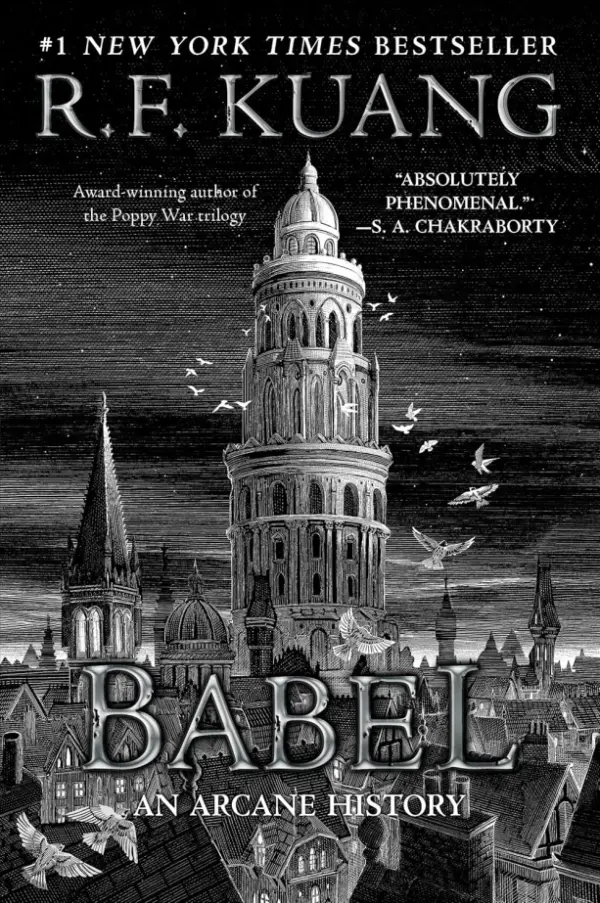
Babel
R. F. Kuang
Average Goodreads rating4.2
- Rebellion Against Oppressive System
- Political and Social Commentary

Book trope · 10 books
Alternate history asks a single, electrifying question: what if it had gone differently? A battle lost instead of won. A discovery made a century too early.
More about the Alternate History trope1 is tagged with Alternate History individually. The others belong to a series tagged with it, which doesn’t mean every book in it features the trope, so they’re marked “Matched via its series”.
Updating books…
10 books found
R. F. Kuang
Average Goodreads rating4.2

Naomi Novik
Temeraire, book 1
Average Goodreads rating4.5
Matched via its series

Naomi Novik
Temeraire, book 2
Average Goodreads rating4.4
Matched via its series

Naomi Novik
Temeraire, book 9
Average Goodreads rating4.6
Matched via its series

Naomi Novik
Temeraire, book 3
Average Goodreads rating4.4
Matched via its series

Naomi Novik
Temeraire, book 8
Average Goodreads rating4.4
Matched via its series

Naomi Novik
Temeraire, book 5
Average Goodreads rating4.6
Matched via its series

Naomi Novik
Temeraire, book 7
Average Goodreads rating4.4
Matched via its series

Naomi Novik
Temeraire, book 6
Average Goodreads rating4.3
Matched via its series

Naomi Novik
Temeraire, book 4
Average Goodreads rating4.5
Matched via its series
Tropes that share the most books with Alternate History
Alternate history asks a single, electrifying question: what if it had gone differently? A battle lost instead of won. A discovery made a century too early. A key figure who lived when history says they died. From that pivot point, the world remakes itself, and fiction gets to follow where reality never went.
The trope sits at the intersection of fantasy, science fiction, and historical fiction, drawing readers who love all three. You get the grounding familiarity of a world built on real events and real places, and then the floor drops away. That tension between the recognisable and the radically changed is where alternate history does its most compelling work.
There's something almost irresistible about counterfactual thinking. Historians do it quietly; alternate history lets writers do it loudly, at novel length, with consequences. Readers who are drawn to this trope tend to love the intellectual pleasure of it — spotting which details the author kept, which they discarded, and how the butterfly effect ripples across centuries.
But it's not purely academic. The best alternate histories use their divergence point to say something pointed about the real world. When a story imagines the Axis powers winning the Second World War, or magic being a known and taxed resource in Victorian Britain, or the Roman Empire never falling, it's really asking us to look at our own history from a new angle. The strangeness is the lens.
The essential ingredient is a clearly established point of divergence from real history. This might be named outright — a date, a battle, a moment — or revealed gradually through the texture of the world itself. Either way, the author must do the work of building internal consistency. The altered world needs its own logic, its own knock-on effects, its own sense that things developed the way they did for reasons.
Alternate history frequently overlaps with other tropes and subgenres. Steampunk often runs on an alternate industrial timeline. Portal fantasy sometimes deposits characters into versions of Earth that never quite match the history books. Gaslamp fantasy loves a Victorian setting where magic was always real and society organised itself accordingly. The trope also turns up in romance — historical romance in particular has embraced alternate timelines as a way to give marginalised characters power and agency they wouldn't have had in the strict historical record.
Some stories focus tightly on a single event and its immediate aftermath, staying close to the divergence point. Others leap forward generations, showing a world so transformed that only careful readers spot the seams. A few take a more playful approach, stacking multiple changes on top of each other until the setting feels genuinely alien while still being rooted in something familiar.
There's also a meaningful distinction between alternate histories that are optimistic — imagining a world that corrected some of history's worst chapters — and those that are deliberately darker, using a nightmare timeline to throw the fragility of the world we actually got into sharp relief. Both are valid, and both ask the same underlying question, just from opposite directions.
Whatever the flavour, the trope rewards readers who want their fiction to do more than one thing at once: to entertain, to provoke, and to leave them looking at a map of the real world slightly differently than they did before.
Occasional emails with new recommendations, series news and trope round-ups.