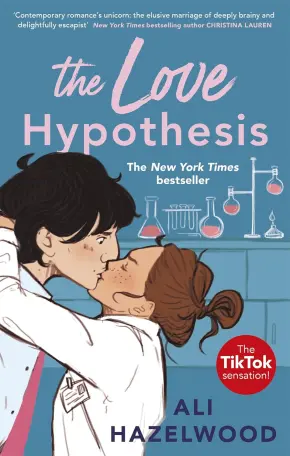
The Love Hypothesis
Ali Hazelwood
Average Goodreads rating4.1
- Witty Banter & Sharp Dialogue
- Grumpy-Sunshine Dynamic

Book trope · 17 books
Workplace romance is exactly what it sounds like — two characters who fall for each other in a professional setting. The office, the hospital, the law firm, the bakery, the royal court.
More about the Workplace Romance trope4 are tagged with Workplace Romance individually. The others belong to a series tagged with it, which doesn’t mean every book in it features the trope, so they’re marked “Matched via its series”.
Updating books…
17 books found
Ali Hazelwood
Average Goodreads rating4.1

Elena Armas
Average Goodreads rating3.8

Lynn Painter
Average Goodreads rating3.5

Christina Lauren
Average Goodreads rating3.6

Christina Lauren
Beautiful, book 1
Average Goodreads rating3.9
Matched via its series

Talia Hibbert
The Brown Sisters, book 1
Average Goodreads rating4.2
Matched via its series

Christina Lauren
Beautiful, book 2
Average Goodreads rating4.1
Matched via its series

Christina Lauren
Beautiful, book 5
Average Goodreads rating4.2
Matched via its series

Christina Lauren
Beautiful, book 3
Average Goodreads rating3.8
Matched via its series

Christina Lauren
Beautiful, book 8
Average Goodreads rating4.0
Matched via its series

Christina Lauren
Beautiful, book 4
Average Goodreads rating3.9
Matched via its series

Christina Lauren
Beautiful, book 6
Average Goodreads rating4.1
Matched via its series

Christina Lauren
Beautiful, book 10
Average Goodreads rating4.1
Matched via its series

Christina Lauren
Beautiful, book 7
Average Goodreads rating4.0
Matched via its series

Christina Lauren
Beautiful, book 9
Average Goodreads rating3.9
Matched via its series

Talia Hibbert
The Brown Sisters, book 2
Average Goodreads rating4.3
Matched via its series

Talia Hibbert
The Brown Sisters, book 3
Average Goodreads rating4.4
Matched via its series
Tropes that share the most books with Workplace Romance
Workplace romance is exactly what it sounds like — two characters who fall for each other in a professional setting. The office, the hospital, the law firm, the bakery, the royal court. Wherever people work alongside one another, friction and feeling have a tendency to follow. The trope thrives on proximity: when you can't avoid someone, when you share deadlines and coffee runs and the particular pressure of a high-stakes project, emotions tend to surface whether you want them to or not.
Readers love it because it's grounded. Unlike love stories built on dramatic coincidence, workplace romance starts with something ordinary — a shared space, a daily routine, a colleague who somehow gets under your skin. That familiarity makes the tension feel real, and the eventual romantic payoff feel genuinely earned.
The defining engine of workplace romance is almost always conflict of interest. There's usually a reason these two people shouldn't get together: one outranks the other, they're competing for the same promotion, company policy explicitly forbids it, or a professional rivalry has made things quietly hostile before they become quietly electric. The workplace setting doesn't just provide a backdrop — it actively creates obstacles.
That professional boundary is what separates this trope from a simple meet-cute. Characters have to manage their feelings alongside their responsibilities, their reputations, their careers. Every lingering glance happens in front of colleagues. Every almost-moment is interrupted by a ringing phone or a looming deadline. The stakes are doubled: you risk not just your heart, but your livelihood.
Boss and employee pairings are perhaps the most prevalent sub-type, leaning hard into the power-imbalance tension. Enemies-to-lovers is a natural companion trope here — professional rivals who respect each other grudgingly before that grudging respect tips into something warmer. Fake-dating within a workplace context adds another delicious layer, as characters maintain a pretence in front of colleagues while the pretence starts feeling uncomfortably real.
The setting itself does a lot of work in shaping the flavour. A high-pressure hospital romance carries different energy to a slow-burn small-town bakery romance, even if the emotional beats are similar. Fantasy and historical romance use the trope too — court intrigue, guild politics, or a new apprentice working beside a reluctant mentor all draw on the same core dynamic of proximity, stakes, and the professional reasons things really ought not to go this way.
There's something deeply satisfying about watching two people try very hard to be sensible and fail completely. The workplace provides built-in reasons for restraint, which means every stolen glance and carefully worded compliment carries more weight than it would elsewhere. Readers get to enjoy the slow build of tension stretching chapter by chapter, knowing that the professional armour will eventually crack.
It also tends to produce sharp, witty characters — people who are competent and guarded and slightly too proud to admit what they're feeling. That combination of professional polish and emotional vulnerability is catnip for romance readers. When those walls finally come down, it means something. After all, the workplace romance doesn't ask whether two people can fall in love. It asks whether they can afford to.
Occasional emails with new recommendations, series news and trope round-ups.