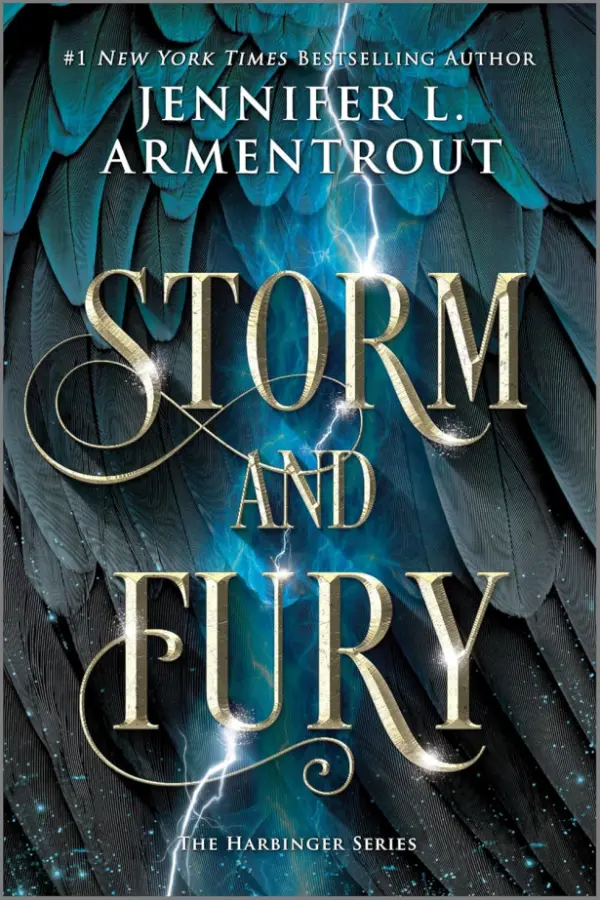
Storm and Fury
Jennifer L. Armentrout
Harbinger, book 1
Average Goodreads rating4.3
- Reluctant Partnership

Book trope · 4 books
At its core, this trope centres a story on a hero or heroine whose physical body presents a genuine, ongoing challenge to the life they're living or the quest they're undertaking.
More about the Protagonist with Physical Limitation trope1 is tagged with Protagonist with Physical Limitation individually. The others belong to a series tagged with it, which doesn’t mean every book in it features the trope, so they’re marked “Matched via its series”.
Updating books…
4 books found
Jennifer L. Armentrout
Harbinger, book 1
Average Goodreads rating4.3

N. K. Jemisin
The Broken Earth, book 1
Average Goodreads rating4.4
Matched via its series

N. K. Jemisin
The Broken Earth, book 2
Average Goodreads rating4.4
Matched via its series

N. K. Jemisin
The Broken Earth, book 3
Average Goodreads rating4.4
Matched via its series
Tropes that share the most books with Protagonist with Physical Limitation
At its core, this trope centres a story on a hero or heroine whose physical body presents a genuine, ongoing challenge to the life they're living or the quest they're undertaking. It might be chronic pain, blindness, deafness, limb difference, a degenerative condition, or the aftermath of catastrophic injury. Whatever the specific limitation, the key is that it shapes how the protagonist moves through the world — practically, emotionally, and socially — rather than disappearing once the plot demands it.
This is quite different from a temporary wound picked up mid-adventure. The limitation is persistent. It's part of the character's identity, their history, and often their hard-won wisdom.
There's something quietly radical about a story that refuses to fix its protagonist. Fantasy and romance both have long traditions of magical healing arcs, and that's fine — but when a writer commits to keeping a character's limitation real and present, readers notice. The result is a kind of authenticity that feels earned rather than convenient.
For readers who live with physical limitations themselves, seeing a protagonist navigate similar challenges — and still fall in love, still save the kingdom, still matter — can be quietly transformative. And for readers without those experiences, there's genuine illumination in following a perspective that reframes what strength actually looks like. Cleverness, lateral thinking, and sheer stubborn persistence tend to come to the fore when brute physical prowess isn't an option.
In fantasy, physical limitation often intersects with magic in fascinating ways. A protagonist who cannot fight with a sword might wield extraordinary power through another channel entirely. Some stories use the limitation to subvert classic chosen-one structures — the hero who was supposed to be someone else, or whose body simply won't cooperate with the prophecy. Others build entire world-building details around how a society treats those who are different, using the protagonist's experience to interrogate power and prejudice.
In romance, the trope tends to carry a particular emotional charge. A love interest who sees a protagonist fully — limitation included, not in spite of it — becomes a meaningful signal of genuine acceptance. The relationship grows around the reality of the character's life rather than a sanitised version of it. Pacing, intimacy, and communication often take on added weight, and the central love story tends to feel grounded in a way that more fantastical wish-fulfilment can't always match.
The trope earns its place when the limitation is written with consistency and specificity — when an author has clearly thought through the daily practicalities rather than only invoking the condition when it's dramatically convenient. The best versions avoid two particular pitfalls: using the limitation purely as a source of angst to be overcome, or using it as a personality substitute, as though suffering is a character trait in itself.
When the protagonist with a physical limitation is written at its best, you get a character who is fully realised, contradictory, funny, flawed, and alive — and whose relationship with their own body is just one part of an absorbing whole. That specificity is what stays with you long after the last page.
Occasional emails with new recommendations, series news and trope round-ups.