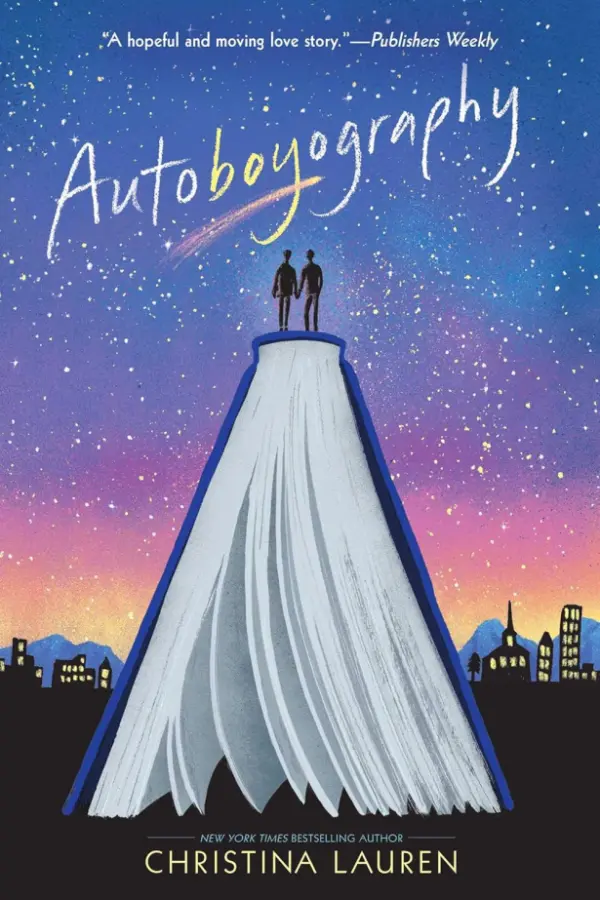
Autoboyography
Christina Lauren
Average Goodreads rating4.6
- Coming of Age
- Forbidden Romance

Book trope · 6 books
At its heart, this trope is about a collision — between what a character has been taught to believe and what they discover to be real. It doesn't have to involve religion, though it often does.
More about the Faith vs Truth trope1 is tagged with Faith vs Truth individually. The others belong to a series tagged with it, which doesn’t mean every book in it features the trope, so they’re marked “Matched via its series”.
Updating books…
6 books found
Christina Lauren
Average Goodreads rating4.6

Brent Weeks
Lightbringer, book 1
Average Goodreads rating4.5
Matched via its series

Brent Weeks
Lightbringer, book 3
Average Goodreads rating4.6
Matched via its series

Brent Weeks
Lightbringer, book 4
Average Goodreads rating4.5
Matched via its series

Brent Weeks
Lightbringer, book 5
Average Goodreads rating4.6
Matched via its series

Brent Weeks
Lightbringer, book 2
Average Goodreads rating4.6
Matched via its series
Tropes that share the most books with Faith vs Truth
At its heart, this trope is about a collision — between what a character has been taught to believe and what they discover to be real. It doesn't have to involve religion, though it often does. Faith here can mean a set of doctrines handed down by a church, a prophecy that has shaped an entire civilisation, or simply the deep, personal conviction that the world works a certain way. When the truth arrives, it tends to be inconvenient. Sometimes devastating.
The tension that drives this trope isn't really about facts winning over feelings. It's about identity. A character whose entire sense of self is built on a particular belief system doesn't simply update their worldview the moment evidence contradicts it. They grieve. They bargain. They sometimes choose the comfortable lie over the painful truth — and readers, uncomfortably, understand why.
Fantasy and romance both deal heavily in worlds that have been constructed with great care, and this trope exploits that construction brilliantly. The moment a character pulls at a loose thread and the whole tapestry of their faith begins to unravel is one of the most viscerally satisfying beats in speculative fiction. There's something almost voyeuristic about watching a belief system collapse from the inside.
It also generates extraordinary emotional stakes without requiring a single sword fight. The internal conflict is the conflict. Readers who've ever questioned something they were raised to hold sacred — a religion, an ideology, a cherished family story — tend to find these narratives almost uncomfortably resonant. The best versions of this trope don't tell you which side was right. They sit with the ambiguity.
In epic fantasy, the trope often plays out on a grand scale: a priesthood built on a lie, a god whose nature turns out to be something entirely different from the scripture, a chosen one who discovers the prophecy was manufactured for political ends. The scale makes the stakes feel cosmic, but the emotional core is always personal — one character, one crisis of belief.
In romantic fantasy and paranormal romance, the same tension appears in smaller, more intimate forms. A character who believes their destined mate or fated bond is sacred may discover that the bond was engineered, or that the person they're bound to has been concealing something fundamental about what they are. Here, faith isn't just religious — it's romantic, which makes the betrayal cut twice as deep.
Secondary characters often carry this trope too. The devout mentor figure who suspects the truth but refuses to look too closely. The zealot whose certainty makes them the most dangerous person in the room. The apostate who found out the hard way and is still, quietly, not entirely over it.
The strongest versions resist the urge to make this simple. A narrative that just says "religion bad, facts good" tends to feel flat, because it refuses to take faith seriously as a human experience. The trope earns its emotional weight when it treats belief — even mistaken belief — as something real and worth mourning. Truth, in these stories, rarely feels like a gift. It feels like a door closing.
There's usually a moment of choice somewhere near the climax: does the character cling to what they were, or step into a world that no longer has a shape they recognise? That moment, handled well, is what this trope is really for. Not the revelation. The reckoning after it.
Occasional emails with new recommendations, series news and trope round-ups.