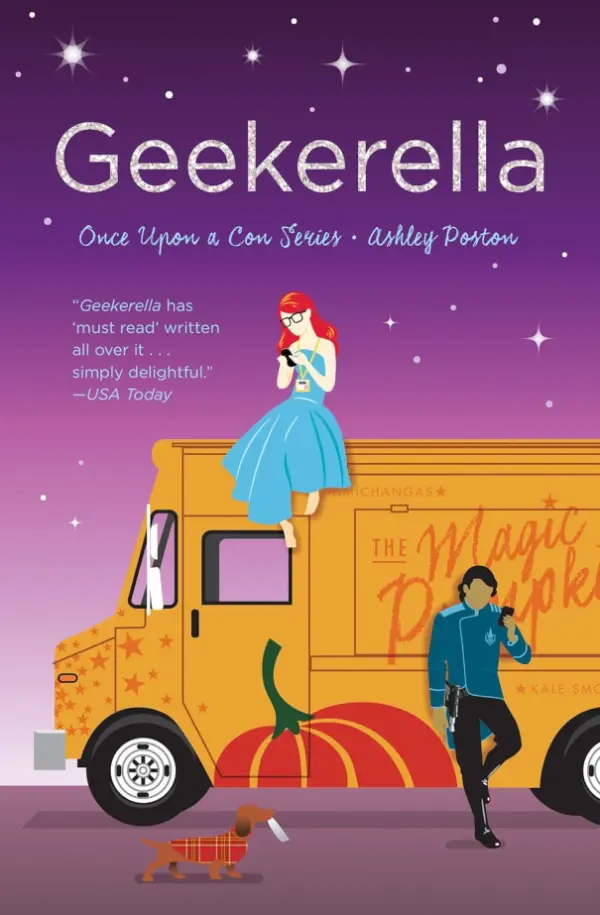
Geekerella
Ashley Poston
Once Upon A Con, book 1
Average Goodreads rating3.9
- Witty Banter & Sharp Dialogue
- Trauma and Healing

Book trope · 1 book
A fairy tale retelling takes a story most readers already carry somewhere in their bones — Cinderella, Beauty and the Beast, Snow White, Sleeping Beauty — and turns it inside out.
More about the Fairy Tale Retelling tropeUpdating books…
1 book found
Ashley Poston
Once Upon A Con, book 1
Average Goodreads rating3.9
Tropes that share the most books with Fairy Tale Retelling
A fairy tale retelling takes a story most readers already carry somewhere in their bones — Cinderella, Beauty and the Beast, Snow White, Sleeping Beauty — and turns it inside out. The bones of the original remain: a recognisable structure, a central image, a familiar dynamic. But the author rebuilds everything around them, asking what happens when you give the silenced character a voice, move the story to a different world, or follow the villain instead of the hero.
Part of the appeal is that particular pleasure of recognition. Readers arrive already oriented, and then the author starts shifting things. That moment when you realise which tale you're reading — when the glass slipper or the poisoned apple clicks into place — is a small, satisfying thrill that straight fantasy rarely offers.
The best retellings aren't just fairy tales with a coat of paint. They interrogate the source material. Why did the original story tell it this way? Whose perspective was missing? What assumptions went unquestioned? A retelling earns its place when the changes feel purposeful — when the author has clearly asked what the old tale was really about and found a new answer worth pursuing.
Common structural signatures include a protagonist who mirrors a fairy tale archetype but refuses to be defined by it, a love interest reframed as a full character rather than a reward, and a magical system or setting that transforms the original's symbolic imagery into something with weight and consequence. The darkness latent in the Grimm originals — the original versions were genuinely grim — tends to surface here, where authors have space to explore it properly.
Retellings span an enormous tonal range. Some are lush, romantic, and steeped in atmosphere, leaning into the fairy tale's dreamlike logic. Others are gritty and politically sharp, using the familiar framework to explore class, power, or gender with real bite. There are retellings set in contemporary high schools and retellings set in secondary worlds so fully realised that the source tale is almost hidden beneath the surface.
The subgenre also crosses genre lines with unusual freedom. You'll find fairy tale retellings shelved in YA fantasy, adult romance, dark fantasy, and literary fiction. Beauty and the Beast alone has generated an almost uncountable number of variants, each finding something different to examine — isolation, consent, transformation, what it means to see past appearances. Cinderella turns up in space operas. East of the Sun and West of the Moon, one of the less prominent fairy tales, has quietly produced some of the most beloved retellings in the genre.
There's something uniquely satisfying about a trope built on the tension between familiarity and surprise. Readers who love retellings often describe reading them as a kind of active pleasure — you're not just following a story, you're in conversation with the original, noticing the choices, feeling the departures. When a retelling makes you see the source material differently afterwards, that's the highest version of what the trope can do.
And honestly? Sometimes you just want the Beast to have better interiority than the 1740 original allowed him.
Occasional emails with new recommendations, series news and trope round-ups.